
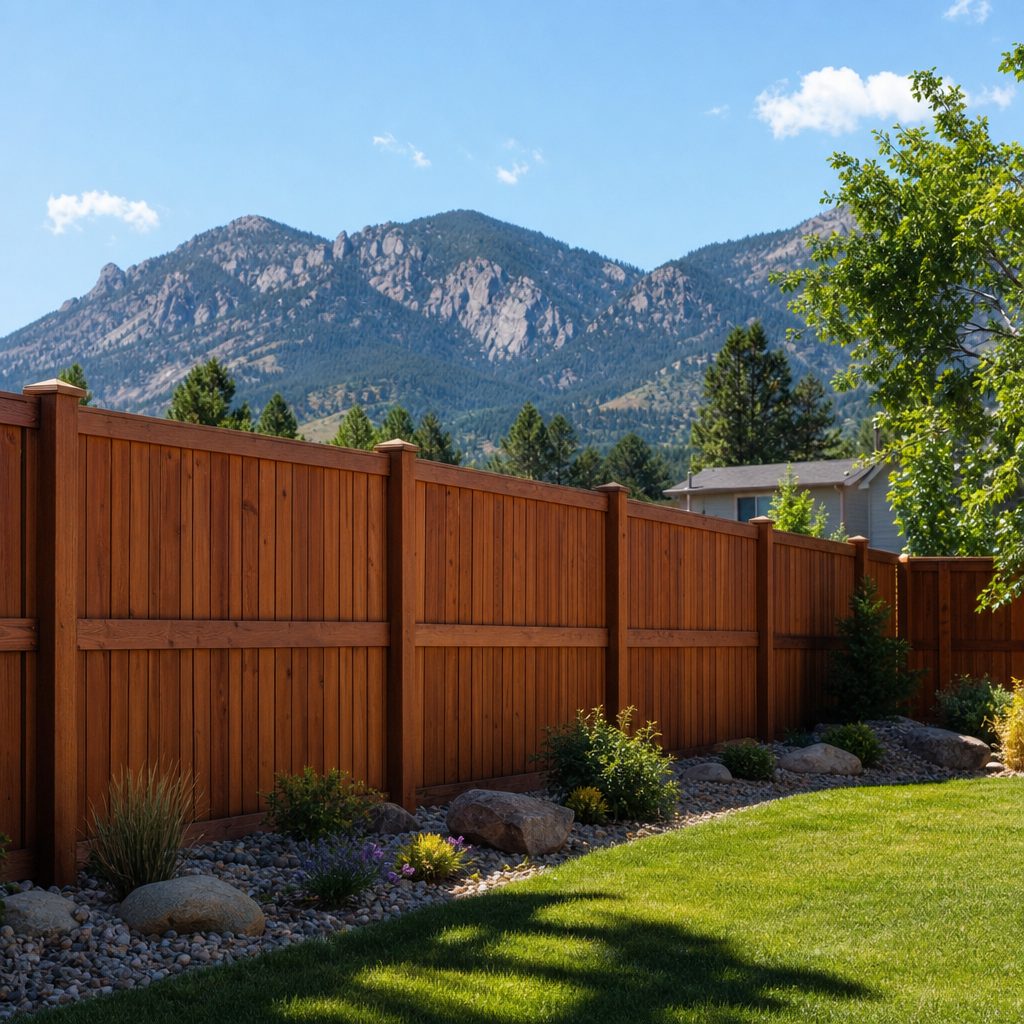
If your fence looks a little dull, gray, or rough around the edges, you're probably wondering whether it's time to restain — or if you can push it another season. The honest answer: it depends. Stain type, wood species, how much direct sun your fence takes, and Colorado's specific climate all play a role. Here's how to think through it.
Average Fence Stain Lifespan by Stain Type
Not all stains are built the same, and the product you use has a bigger impact on longevity than most homeowners realize.
- Solid stains: 3–5 years. These behave most like paint — they coat the surface and block UV. They last longer but peel over time, and recoating is more involved because you're dealing with a film-forming product.
- Semi-transparent stains: 2–4 years. These penetrate the wood grain and still let texture show through. They wear more gracefully than solid stains — instead of peeling, they fade — which makes timing your refresh easier.
- Clear sealers and water repellents: 1–2 years max. These protect against moisture but offer minimal UV defense. In Colorado's high-altitude sun, they break down fast and are generally not worth using as a standalone product on fences.
For most Northern Colorado homeowners, a quality semi-transparent or semi-solid penetrating stain hits the sweet spot between longevity and ease of maintenance.
Wood Species Matters More Than Most People Think
The wood your fence is made of affects how well it holds stain and how long that protection lasts.
- Cedar: Naturally rot-resistant and takes stain extremely well. With the right product, a cedar fence in this region can hold a semi-transparent stain for 3–4 years before needing a refresh.
- Pressure-treated pine: Common and affordable, but it absorbs stain unevenly and tends to check and crack as it ages. Expect 2–3 year cycles.
- Spruce and other softwoods: Less stable under Colorado's freeze-thaw stress. More frequent maintenance — sometimes every 1–2 years — is realistic.
If you're not sure what your fence is made of, a contractor can tell you on-site and recommend the right product accordingly.
Colorado's Climate Shortens the Clock
This is where Northern Colorado diverges from national averages you'll find on product labels.
At elevations around 5,000 feet, UV radiation runs 10–15% higher than at sea level. Combined with 28+ freeze-thaw cycles per year, the result is accelerated breakdown of any surface coating. A stain rated for 4 years in a moderate climate might only hold 2–3 years here in Timnath or Windsor before it starts losing its protective value.
South and west-facing fence sections take the most punishment. If your fence runs along a south-facing property line with no shade coverage, plan to be on the shorter end of any lifespan estimate. Shaded or north-facing sections will hold stain noticeably longer.
Signs Your Fence Needs Restaining (Before It Fails)
Waiting until wood starts rotting or checking severely means you've already lost ground. Here are the early warning signs to watch for:
- Water no longer beads on the surface. Do a simple splash test — if water soaks straight in rather than beading up, the protective barrier is gone.
- Graying or fading color. UV is breaking down the stain. Catching it at this stage means you can often clean and recoat without stripping.
- Rough, raised wood grain. The wood is starting to dry out. Left unaddressed, this leads to cracking and checking.
- Soft or spongy spots. Moisture has been getting in. At this point you're dealing with early-stage rot, and restaining alone won't fix it.
The best move is to restain before you see the last two signs. Once wood starts checking or going soft, you're doing damage repair, not maintenance.
What a Realistic Maintenance Schedule Looks Like
For a cedar or pine privacy fence in Timnath, Windsor, or the surrounding area, a reasonable expectation with a quality penetrating stain is:
- First application on new wood: Wait 3–6 months for pressure-treated wood to dry out fully. Cedar can be stained sooner.
- First refresh: 2–3 years after initial application, depending on exposure.
- Ongoing cycle: Every 2–4 years with proper prep (cleaning, light sanding if needed) before recoating.
Skipping prep is the fastest way to cut that lifespan in half. Stain applied over dirty, weathered wood won't penetrate properly and will fail early.
Getting It Right the First Time
If you're in the Timnath, Windsor, or greater Northern Colorado area and your fence is due for staining, the prep work and product selection matter as much as the application itself. Our fence staining work is done with products chosen specifically for Colorado's altitude, UV load, and temperature swings — not generic national-label products that assume a milder climate.
We also offer exterior staining for decks and other wood surfaces if you're looking to knock out multiple projects at once.
Want a straight answer on what your fence actually needs? Get a free on-site quote and we'll give you a realistic assessment — what condition the wood is in, what product makes sense, and what you can expect it to last.